


You’ve published dozens of blog posts. Your on-page SEO looks decent. Yet your organic traffic has been flat, or dropping, for months. Sound familiar? You’re not alone. Most SaaS companies are making the same handful of SEO mistakes over and over, and the painful truth is that many of them don’t even realize it.
With over 31,000 SaaS companies competing for attention online, the margin for error is razor-thin. A single structural mistake, wrong keywords, broken internal linking, or a friction-heavy free trial page can quietly bleed you of hundreds of qualified leads every single month.
In this guide, we break down the 9 most common SaaS SEO mistakes we see across B2B and B2C software companies, from keyword strategy blunders to UX issues that crush conversion rates. More importantly, we’ll show you as a SaaS SEO Expert exactly how to fix them.
For Learn About: What Is Off-Page SEO? Click Here!
Quick Answer:
The most common SaaS SEO mistakes include: targeting keywords with wrong intent, ignoring technical SEO, broken internal linking, thin or misaligned content, poor UX on landing pages, not optimizing free trial pages, outsourcing marketing without strategy, embedding product demos incorrectly, and failing to track the right metrics.
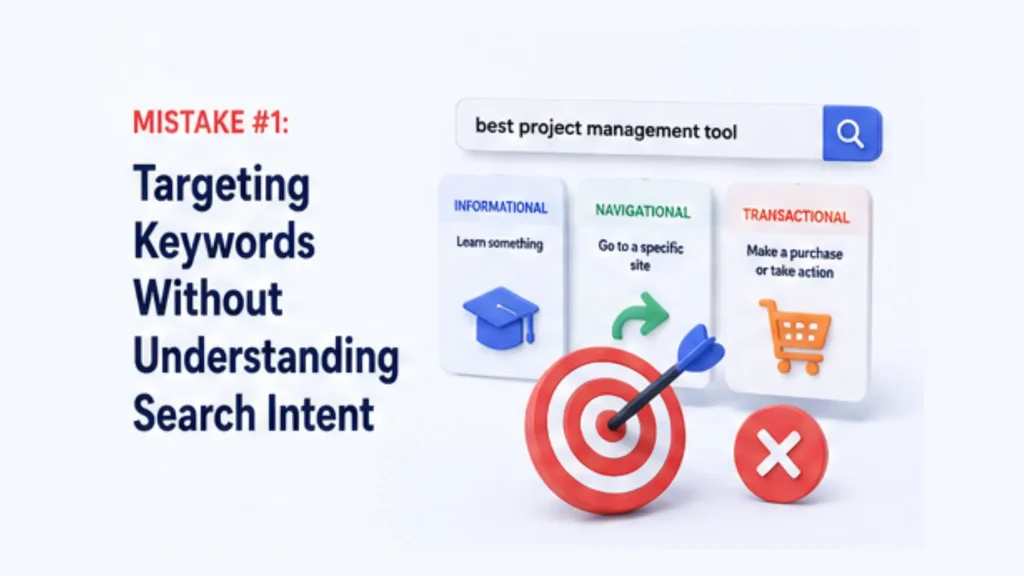
Mistake #1: Targeting Keywords Without Understanding Search Intent
This is perhaps the most expensive common SaaS SEO mistake a company can make. You invest time writing a detailed feature page, optimize it for a high-volume keyword like “project management software,” and still rank on page 4. Why? Because you ignored what the searcher actually wanted when they typed that query.
Search intent, the underlying goal behind a search query, is what Google’s algorithm prioritizes above almost everything else. Someone searching “best CRM software” is comparison-shopping, not ready to buy. Someone searching “buy CRM for small business” is. Sending both to the same landing page destroys your conversion rate and signals poor relevance to Google.
How to Fix It
- Segment keywords by intent: informational, navigational, commercial, and transactional.
- Use problem-specific and long-tail keywords (e.g., “how to automate invoice approvals”) alongside broader terms.
- Map each keyword to the correct page type: blog post, comparison page, landing page, or pricing page. Tools like Ahrefs or Semrush are invaluable here.
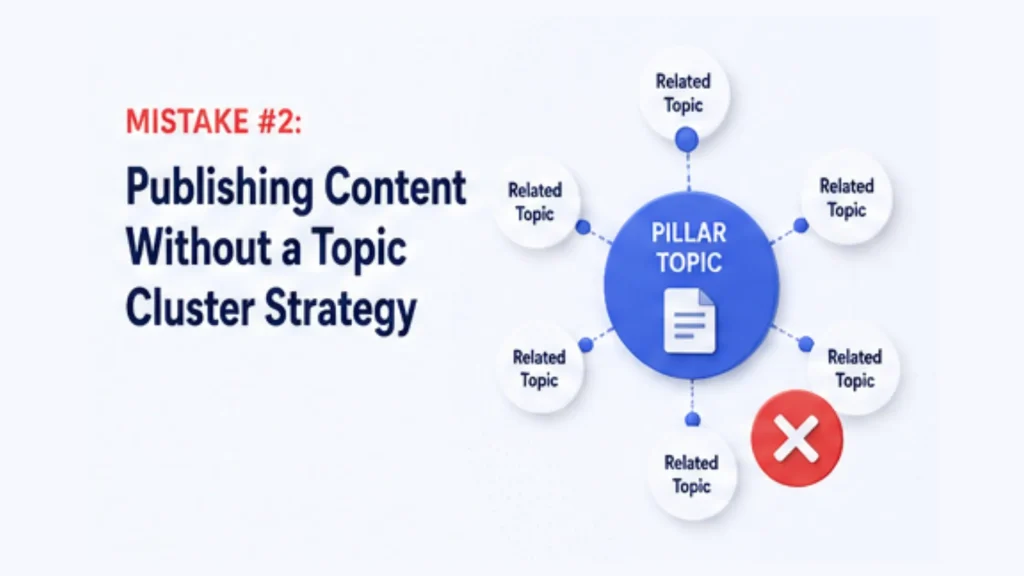
Mistake #2: Publishing Content Without a Topic Cluster Strategy
Random blog posts don’t build authority; topic clusters do. One of the most frequently overlooked common mistakes in SaaS content strategy is publishing articles on scattered subjects with no structural relationship among them. Google rewards websites that demonstrate deep expertise on a subject, not those that touch everything shallowly.
When your SaaS blog covers project management, email marketing, HR software, and remote work in random succession, with no pillar pages tying topics together, search engines can’t determine what your site is actually authoritative about. The result? You rank for nothing consistently.
How to Fix It
- Choose 3–5 core topic pillars directly tied to your product’s core use cases.
- Create a comprehensive pillar page for each topic (2,000–4,000 words) targeting a broad keyword.
- Publish supporting cluster articles targeting specific, long-tail related queries — each linking back to the pillar.
- Interlink cluster articles with each other where contextually relevant.
For Learn About: Why Generative Engine Optimization is Important, Click Here!
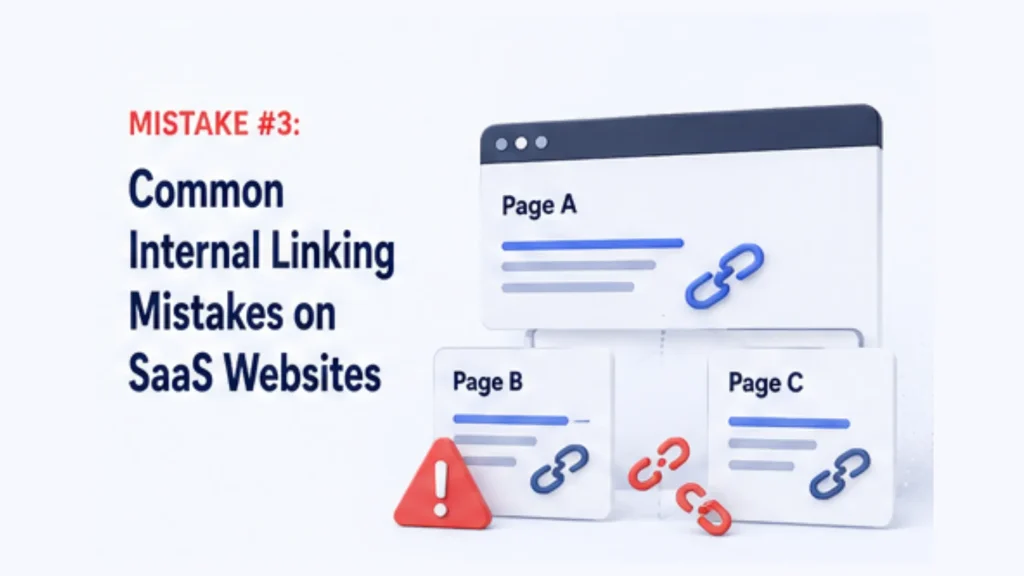
Mistake #3: Common Internal Linking Mistakes on SaaS Websites
Poor internal linking is one of those common SaaS SEO mistakes that sits quietly in the background, destroying your rankings. It’s not as obvious as a 404 error or a missing meta title, but the compounding damage is just as real.
Here are the internal linking mistakes we see most often on SaaS websites:
- Orphan pages: blog posts and landing pages that no other page links to. Google struggles to find and index them.
- Generic anchor text: Using phrases like “click here” or “learn more” instead of descriptive, keyword-rich anchors tells Google nothing about the linked page’s content.
- JavaScript-gated pagination: many SaaS blogs load older posts behind a “Load More” button powered by JavaScript. Google often doesn’t interact with these buttons, meaning dozens of your older posts become effectively invisible to crawlers.
- Over-linking: cramming 15+ internal links into a single post dilutes the value passed to each linked page.
- No link to high-conversion pages: blog posts that never link to your pricing page, free trial page, or demo page miss the entire commercial point of content marketing.
How to Fix It
- Run a monthly orphan page audit using Screaming Frog or Sitebulb.
- Replace all generic anchor text with descriptive, keyword-varied phrases.
- Replace JavaScript pagination with HTML-based pagination to ensure full crawlability.
- Ensure every blog post includes at least one link to a bottom-of-funnel page (pricing, demo, free trial).
External Reference: Google’s guidance on internal linking
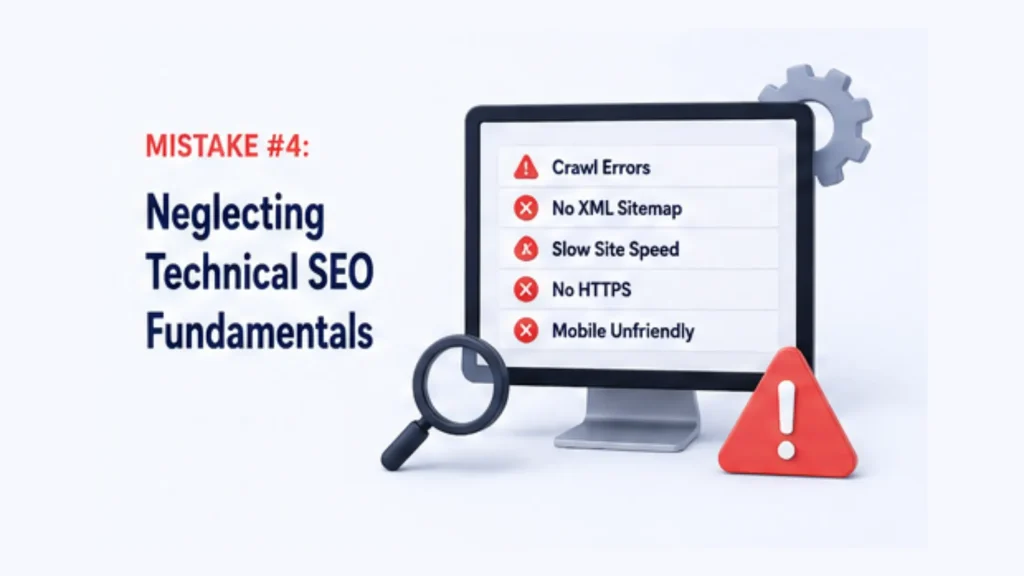
Mistake #4: Neglecting Technical SEO Fundamentals
Even the most brilliant content strategy won’t save a technically broken website. A 2-second loading delay can increase abandonment rates by up to 87%. Yet many SaaS companies spend thousands on content while ignoring page speed, crawl errors, and indexation issues.
Common technical SaaS SEO mistakes include: duplicate content across pricing tiers, canonicalization errors on product pages, bloated JavaScript that slows Core Web Vitals, and app subdomains (app.yourproduct.com) that are completely disconnected from the marketing site’s domain authority.
The Quick Technical Audit Checklist
- Run a crawl with Screaming Frog, fix all 4XX errors, and redirect chains.
- Audit Core Web Vitals in Google Search Console, target LCP under 2.5s, CLS under 0.1.
- Ensure your app subdomain passes link equity back to your marketing domain where possible.
- Check for duplicate content caused by faceted navigation or URL parameters.
- Submit a clean XML sitemap and verify all priority pages are indexed.
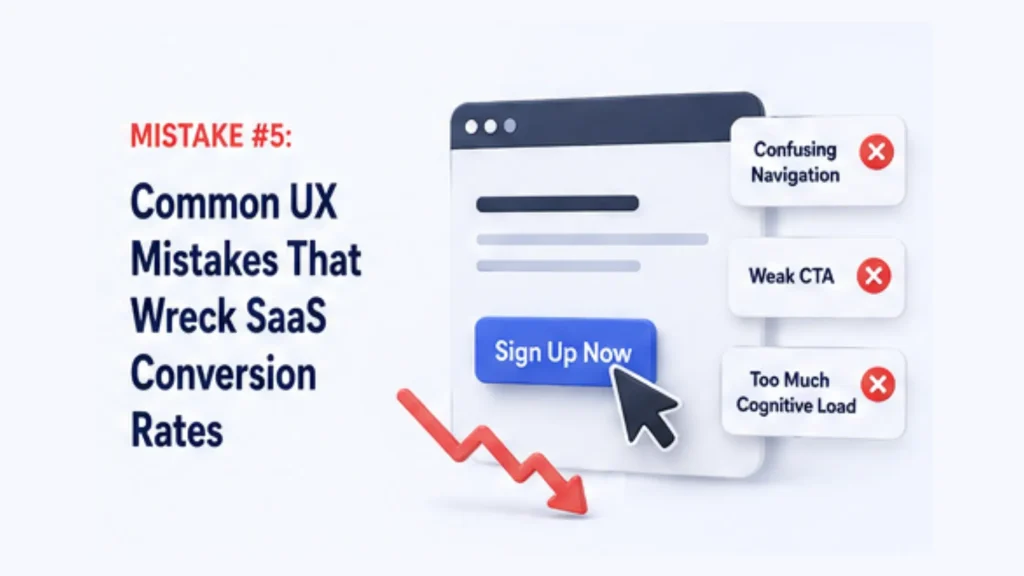
Mistake #5: Common UX Mistakes That Wreck SaaS Conversion Rates
SEO gets people to the door. UX decides whether they walk in. This is where a shocking number of SaaS companies lose the plot entirely. You can rank on page one for a competitive keyword, but if your landing page is confusing, slow, or unclear about its value proposition, you’ve spent your entire SEO budget to generate nothing.
The most damaging common UX mistakes on SaaS websites include:
How to Fix It
- Rewrite your hero section headline around a specific outcome for a specific persona.
- Reduce your signup form to the bare minimum; email and password are enough to start.
- Add a visible trust bar (logos, ratings, review count) directly beneath your main CTA.
- A/B test your CTA button copy “Start Free Trial” consistently outperforms “Get Started.”
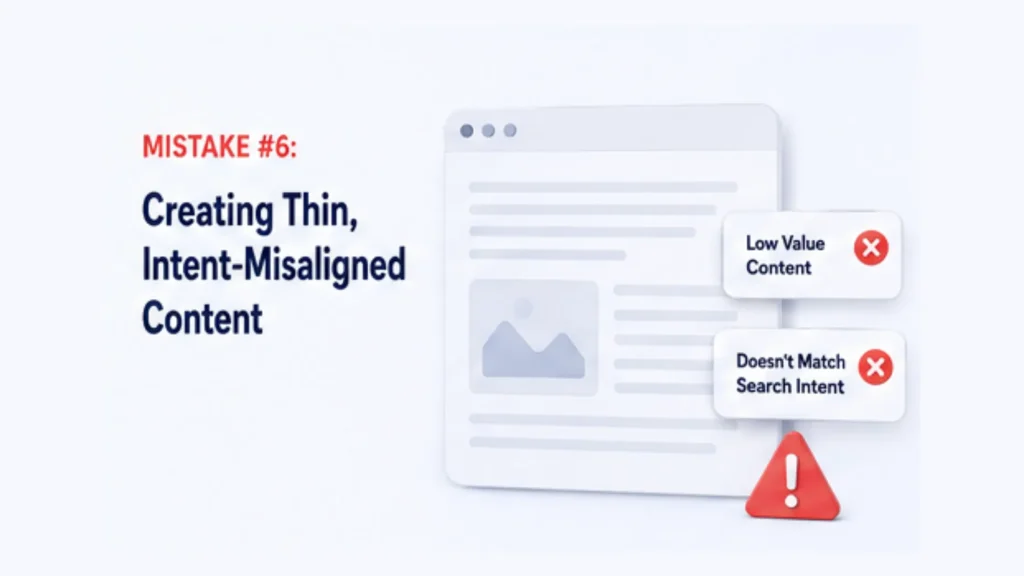
Mistake #6: Creating Thin, Intent-Misaligned Content
Google’s Helpful Content System, now a core part of its ranking algorithm, is specifically designed to identify and penalize content that exists to rank rather than to genuinely help readers. If your blog posts are 400-word summaries stuffed with keywords, or if your comparison pages offer no real insight, you’re not just failing users, you’re signaling to Google that your site isn’t trustworthy.
The data backs this up: 90.63% of pages receive zero organic traffic from Google, primarily due to poor keyword selection and thin, low-value content.
The Fix: Write for Depth and Specificity
- Every post should answer the specific question a searcher typed, not just a topic adjacent to it.
- Include real-world examples, screenshots, data points, and original perspective, not generic advice.
- Aim for content that covers a topic more thoroughly than any competitor currently ranking for it.
- For every three informational posts, publish one commercial-intent piece (comparison, alternative, or “best X for Y” format).
Content audits are not optional. Review underperforming content quarterly. Pages with minimal traffic and low engagement should be either improved substantially or consolidated via a 301 redirect into stronger pages.
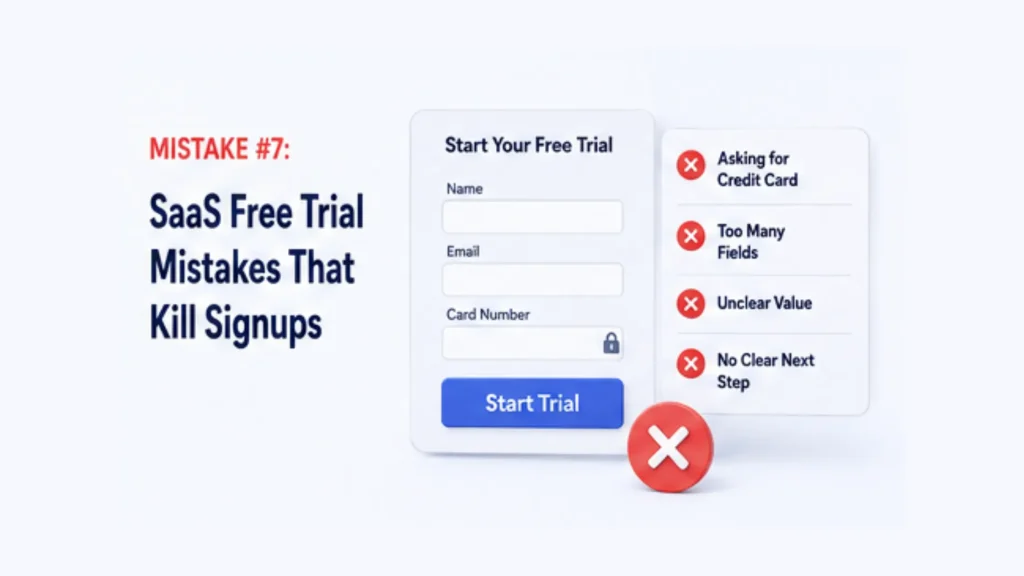
Mistake #7: SaaS Free Trial Mistakes That Kill Signups
Your free trial page is one of the most commercially valuable pages on your entire website. It sits at the bottom of the funnel, captures intent at its highest, and yet it’s one of the most neglected pages from an SEO perspective and one of the most friction-filled from a UX perspective.
Common SaaS Free Trial Mistakes
How to Fix It
- Remove credit card requirements from your initial trial signup.
- Optimize the free trial page with relevant long-tail keywords around “free trial” intent.
- Rewrite the CTA to include a specific outcome promise (e.g., “Send your first campaign in 10 minutes free for 14 days”).
- Set up an email onboarding sequence triggered on day one of the trial.
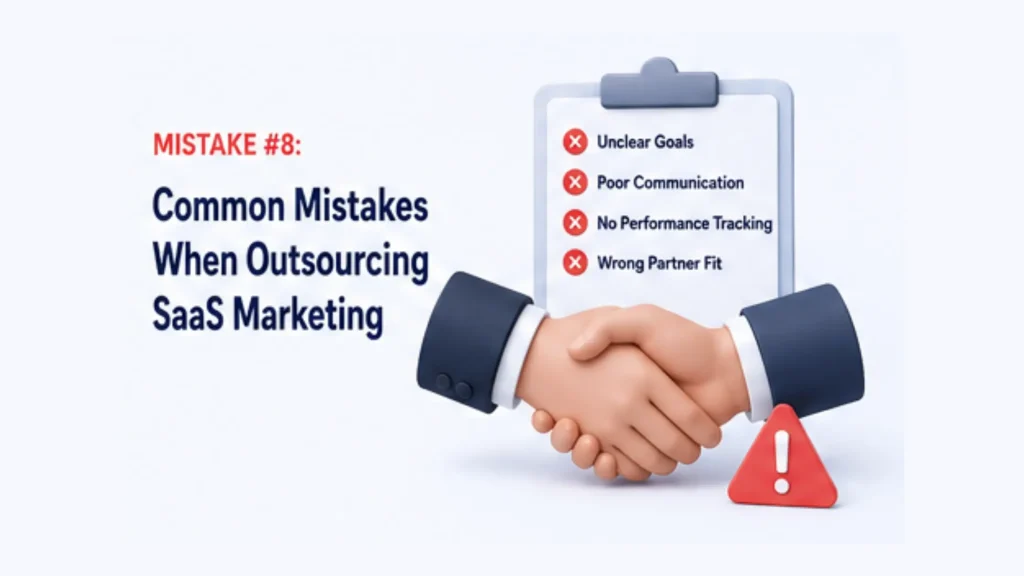
Mistake #8: Common Mistakes When Outsourcing SaaS Marketing
Outsourcing content creation and SEO is not inherently a mistake. Done right, it accelerates growth significantly. Done wrong and it very often is done wrong, it produces a flood of generic, low-quality content that tanks your domain’s credibility and wastes your budget.
The Most Dangerous Outsourcing Mistakes
How to Fix It
- Create a detailed content brief template covering: topic, target keyword, search intent, audience persona, key points to cover, internal links to include, and CTA.
- Assign an internal product expert to review all outsourced content before publication.
- Build author bio pages for all contributors with verifiable credentials.
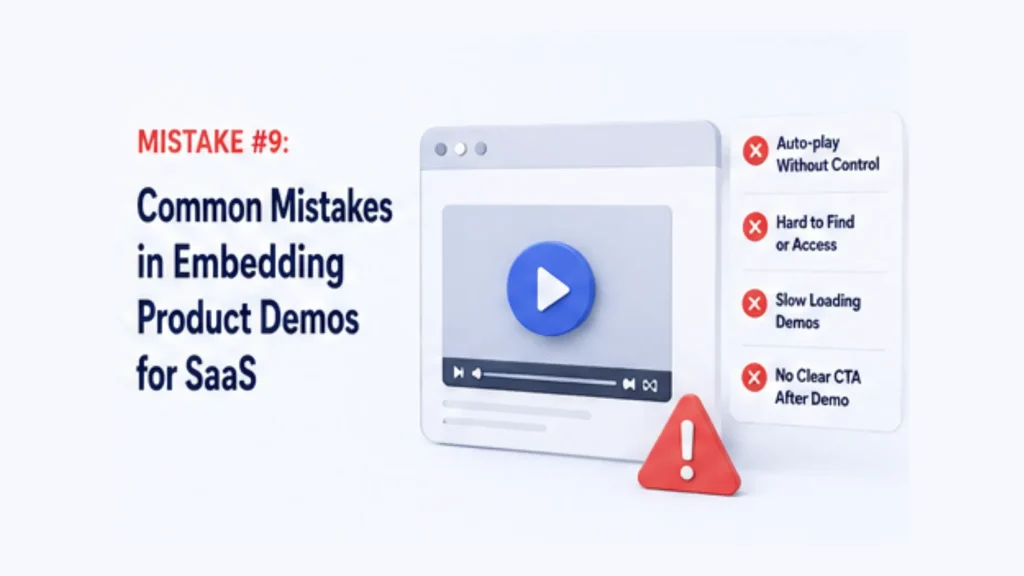
Mistake #9: Common Mistakes in Embedding Product Demos for SaaS
Product demos and interactive walkthroughs are among the most powerful conversion tools a SaaS company has. But the way most companies implement them creates a cascade of SEO and UX problems that quietly undermine everything.
Embedding Mistakes That Hurt You
How to Fix It
- Always surround demo embeds with substantial, keyword-rich descriptive text explaining what the demo shows.
- Use lazy-loading for video embeds to minimize impact on Core Web Vitals.
- Offer both a gated and ungated version of your demo, a brief teaser visible to all, with full access after email capture.
- Implement the VideoObject schema for all embedded demo videos.
For Learn About: How Much Does SEO Cost? Click Here!
Frequently Asked Questions: SaaS SEO Mistakes
The most common SaaS SEO mistakes include targeting keywords with the wrong search intent, ignoring technical SEO fundamentals like Core Web Vitals, failing to build topic clusters, poor internal linking structure, thin or duplicated content, UX friction on landing pages, under-optimized free trial pages, poor outsourcing practices, and improper product demo embedding.
Internal links help Google discover and understand your site architecture, distribute link equity to your most commercially important pages, and guide users through a logical content journey. Common SaaS internal linking mistakes like orphan pages, generic anchor text, and JavaScript-gated archives can make dozens of your pages effectively invisible to search engines.
Free trial pages are high-intent pages that, when properly optimized for both conversions and search, can rank for valuable bottom-of-funnel keywords like “free [category] software trial.” Most SaaS companies neglect these pages entirely from an SEO standpoint and also add unnecessary friction (like credit card requirements) that suppresses conversion rates.
Outsourcing without a documented strategy and expert review process leads to generic, E-E-A-T-deficient content that fails both users and Google’s quality raters. The solution isn’t to avoid outsourcing; it’s to implement strict content briefs, internal SME review, and author credentialing systems before any content goes live.
Google’s ranking algorithm factors in user behavior signals, including bounce rate, dwell time, and Core Web Vitals scores. Poor UX, slow pages, confusing navigation, weak value propositions increase bounce rates and reduce dwell time, both of which signal to Google that your page isn’t satisfying searcher intent. This directly suppresses rankings over time.
Conclusion: Stop Losing Rankings to Fixable Mistakes
SEO for SaaS is not a mystery. The gap between SaaS companies that grow consistently on organic search and those that plateau often comes down to the same set of avoidable, common SaaS SEO mistakes: misaligned keywords, broken internal linking, UX friction, thin content, and neglected high-intent pages.
The good news: every mistake in this guide has a clear, actionable fix. You don’t need to solve all nine at once. Start with a technical audit, then move to content alignment, then optimize your highest-intent pages: your free trial page, your demo page, and your pricing page.
Organic search compounds. Every improvement you make today pays dividends for months and years ahead. But the longer you wait, the more ground your competitors gain.
For Learn About: How to Do Keyword Research for SEO, Click Here!
Ready to Fix Your SaaS SEO Mistakes?
I specialize in SaaS SEO, from technical audits to content strategy to conversion optimization. I helped SaaS companies recover rankings, build topic authority, and turn organic traffic into a real pipeline.